October 15, 2026: AQADOC Workshop -Distributed Quantum Computing: From Algorithms to Applications |

|
October 15, 2026: AQADOC Workshop -Distributed Quantum Computing: From Algorithms to Applications
How can Distributed Quantum Computing move from research to real-world applications?
Join us on October 15,2026, at EDF Lab, Paris-Saclay, for a full day bringing together researchers, quantum technology developers and industrial players to discuss distributed quantum algorithms, architectures and industrial applications.
 Discover the programme and register here Discover the programme and register here 
|
 |
EXCELLERAT2 Webinar "User Journey: Industrial HPC access with SCALES", September 30 |
 |
Join us on September 30, 2026, from 11:00 to 12:00 CET, for the next EXCELLERAT-2 webinar in the series "Opportunities for Collaboration around HPC, HPDA and AI".
This session, "User Journey: Industrial HPC Access with SCALES", organized with Marvin Hubl from SSC, will explore collaboration opportunities around CAE, simulation and industrial HPC access.
Register here |
|
Gray Scott School 2026:
THANK YOU! |

|
Gray Scott School 2026 has come to an end after two inspiring weeks dedicated to High Performance Computing.
A heartfelt thank you to everyone who contributed to making this edition a success:
• 1 week on CPU and 1 week on GPU
• 600+ participants
• 31+ countries represented
• 19 satellite sites, alongside the main venue in Annecy
• 320 participants connected on average each day
Beyond these figures, what truly made this edition memorable were the lively discussions, knowledge sharing, new collaborations, and the strong sense of community built throughout the two weeks.
The journey doesn't end here! Session replays will soon be available on our YouTube channel, and our Discord server remains open for discussions, questions, and future HPC opportunities.
Thank you for being part of the Gray Scott School community. We look forward to welcoming you again for the next edition!
 |
 |
10 June: AI and Numerical Simulation Seminar |
 |
NAFEMS and Teratec are inviting you on 10 June in Paris for a seminar dedicated to the integration of artificial intelligence and numerical simulation. Join experts, researchers and industry professionals to explore the challenges and opportunities of integrating AI into the simulation processes of complex systems.
Topics covered will include application aspects, algorithmic aspects and strategic considerations. Don't miss this unmissable event to stay at the forefront of innovations in AI and numerical simulation, and to network with key players in the field!
Download the slides here |
|
FFplus Webinars invitation: Accelerating SMEs Business Value with High-Performance Computing |
 |
High-performance computing is no longer confined to laboratories; it is the new engine of industrial competitiveness.
Join FFplus for our upcoming webinar series, 'Accelerating SME Business Value with High-Performance Computing', in which we explore the work of pioneers bridging the gap between advanced computing and real-world business value.
Each session draws on success stories to demonstrate how to maximise the impact of SMEs, bridge the gap between high-performance computing and value creation for SMEs, and boost the competitiveness of SMEs
Register to the webinars here and learn about how strategic HPC integration is redefining industrial competitiveness and get inspired!
|
 |
FFplus Announcement: 16 Innovations Studies success stories are published! |
 |
The first tranche of FFplus Innovation Studies has been successfully finalised. Stories are showcasing the outstanding work, innovation, and real-world business impact delivered by 16 sub-projects.
Explore the stories in different formats:
Website
Success Stories booklet
Videos
|
|
Gray Scott Thursdays |

|
We are launching the 2026 edition of the Gray Scott School with the series "Gray Scott Thursdays" webinar!
Every Thursday, dive into the fundamentals of high-performance computing alongside our expert instructors: CPU/GPU architectures, memory management, profiling, testing, and modern programming languages such as C++, Kokkos, Fortran, Python, Julia… and more!
More Information
Register now
|
|
FFplus European Innovation Showcase: Strategic Integration of AI & High-Performance Computing |
SMEs: Turn Innovation into Impact with HPC & GenerativeAI!
Are you an #SME looking to scale your innovation, accelerate development, and gain a real competitive edge? Join us for an exclusive FFplus webinar series where SMEs take the stage to showcase how they transformed innovation studies into market-relevant solutions using HPC and Generative AI.
What's in it for you?
✔ Real SME success stories — presented by the companies themselves
✔ Practical insights into using HPC & Gen-AI to boost performance and scalability
✔ Concrete, industry-driven use cases with tangible business impact
✔ Inspiration on how advanced computing can strengthen your global competitiveness
These webinars highlight how the synergy of HPC and AI is no longer just for large enterprises. SMEs are already leveraging it to innovate faster and smarter.
Event Details
Webinar 1:
February 18, 2026 | 14:00–17:00 CET
Webinar 2:
February 20, 2026 | 14:00–17:00 CET
|
 |
|
Ready to bring quantum theory into practice? |
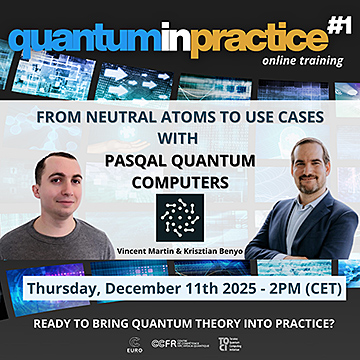 |
The first session of the Quantum in Practice series has successfully taken place. Organized by Teratec (CC-FR /TQCI), this hands-on technical training featured Pasqal, pioneers in neutral-atom quantum computing. Participants explored practical coding exercises using Pasqal's open-source #Pulser library.
The recording of the session is now available online.
Additional webinars will follow throughout 2026. To stay informed and receive updates, subscribe to our newsletter. |
|
Teratec Forum 2026, the meeting place for digital players |
|
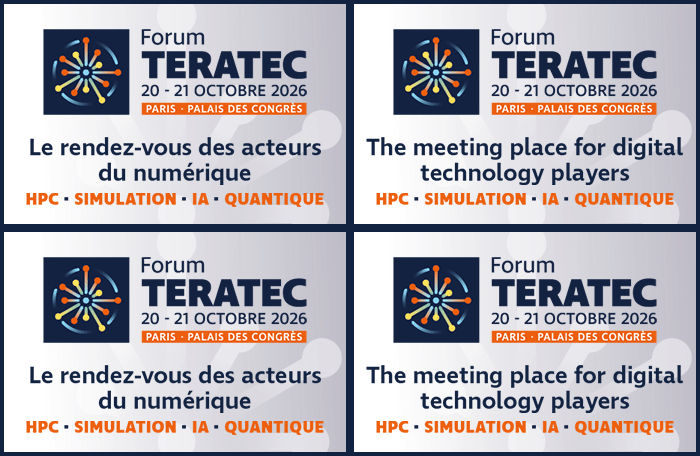
The Teratec Forum is a leading European event dedicated to HPC, simulation, AI, and quantum computing. Every year, it brings together manufacturers, researchers, decision-makers, and technology experts to discuss innovations that are transforming strategic sectors. The 21st edition will be held on October 20 and 21, 2026, at the Palais des Congrès in Paris. The program includes plenary conferences, round tables, workshops, and an exhibition area featuring a wealth of demonstrations. It is an unmissable event for anticipating the uses and technological breakthroughs of tomorrow.
|
|
Discover the MINERVA project |
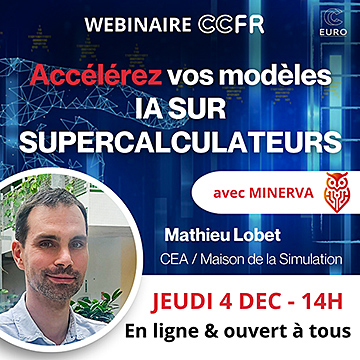 |
Mathieu Lobet (CEA / Maison de la Simulation) will present how MINERVA supports researchers, engineers, and companies in:
• bringing their AI workflows to HPC infrastructures,
• optimizing their models on a large scale,
• and leveraging EuroHPC resources for their AI projects.
Thursday, December 4, 2025 - 2:00–3:00 p.m. (CET)
Online – in French
Watch the replay here |
|
| AQADOC: 2nd Scientific Day! |
 |
We are pleased to announce the 2nd AQADOC Scientific Day, which will take place on October 9th, 2025, from 9:00 AM to 4:00 PM at the French National Institute for Art History (INHA) in Paris.
Following the success of the first workshop in October 2024, this new edition will once again convene leading experts and stakeholders to highlight the latest achievements of the AQADOC project.
The day will conclude with a lively panel discussion bringing together the morning's speakers, members of the AQADOC consortium, and the wider community interested in the future of distributed quantum computing.
|
|
Gray Scott School 2025 : Europe's leading HPC Summer School! |
|
|
GSS2025 wrapped up beautifully! A huge thank you to all the 500 participants, speakers, partners from 8 countries, and sponsors who helped make this edition such a rich and inspiring experience.
The GSS is a summer school designed to sharpen your HPC skills in programming and optimization on heterogeneous architecture (CPU & GPU). If you missed it:
- Replays will be available online soon.
- The Discord server remains open for ongoing conversations.
And yes… we're already working on GSS2026! See you soon!
More Information
|
|
FF+: Open Call Statistics and Sub-project Announcement |
The First FFplus Open Calls and were Successful: 19 Sub-projects for Business Experiments and 18 Sub-projects for Innovation Studies were Selected for Funding
Read the Press Release on Business Experiments Open Call results and statistics
Read the Press Release on Innovation studies Open Call results and statistics |
 |
|
New President at Teratec! |
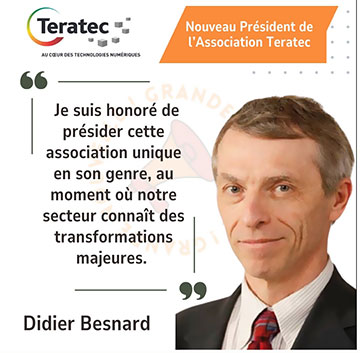 |
We are delighted to announce the election of Didier BESNARD as President of the Teratec Association, succeeding Daniel Verwaerde.
With a rich background in advanced technologies and recognised expertise in High-Performance Simulation, Didier Besnard embodies an ambitious dynamic around the major challenges of digital technology. |
| Find out more about the Teratec team here. |
|
|
|
4 and 5 November : TQCI seminar on benchmarks for quantum computers |
 |
The fourth edition of the TQCI International Conference on Quantum Computing Benchmarking
will examine how quantum computing benchmarking is evolving as the technology moves towards fault-tolerant quantum computing and becomes increasingly accessible to users. It will bring together system-level and application-level approaches, explore resource estimation and address benchmarking evolutions as access to QC increases .
Programm and registration |
|
Unlocking HPC Performance with AMD Tools & GPUs |
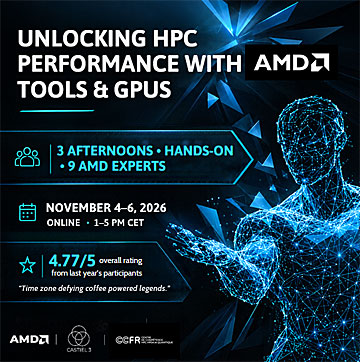 |
How do you get the most out of AMD GPUs for your HPC applications?
Join us November for three hands-on afternoons dedicated to porting, optimizing and profiling HPC applications on AMD systems.
Whether you're moving code from CPUs or another GPU platform, looking to optimize an existing application, or wanting to get to grips with the AMD software ecosystem, this training will take you from the fundamentals to advanced performance optimization.
And this isn't just theory: every module includes practical exercises, with remote access to AMD infrastructure through the AMD Accelerator Cloud.
Agenda & Registration
|
|
September 23rd, 2026 : SEMINAR on Semiconductor industry advancing quantum |
 |
How is the quantum semiconductor industry organizing itself to maximize value creation across the supply chain?
The industrialization potential of spin qubits requires the active involvement of stakeholders throughout the semiconductor value chain. Key industry players will present their roles, strategies, and collaborative approaches to enable the development and scaling of quantum semiconductor technologies.
Information & registration |
|
EUMASTER4HPC2: EUMaster4HPC enters a new phase |
 |
The EUMaster4HPC programme has reached a major milestone with the signature of its new Grant Agreement, securing six more years of European excellence in advanced computing education.
Funded by the EuroHPC Joint Undertaking with a €10 million budget and coordinated by the University of Luxembourg, the programme will train 400 students over the next six years in HPC, AI and Quantum Computing.
Starting in September 2026, the curriculum will be expanded with a stronger focus on AI and Quantum Computing, providing students with the interdisciplinary skills needed to drive the next generation of computational innovation.
With 43 partners from 23 countries, including Teratec, EUMaster4HPC offers a unique European learning experience. This combines a double degree, international mobility, and hands-on projects with leading academic, research, and industrial partners..
- Applications are open until 15 August 2026 for undergraduate STEM students with strong programming skills. More information here |
|
Ready to bring quantum theory into practice? |
 |
For this fourth session, we will welcome Alain Champenois from Quobly.
During this session, participants will discover:
• the emerging paradigm of Quantum Reservoir Computing (QRC) and its potential for next-generation quantum applications
• how quantum systems can be harnessed to process complex temporal data with high efficiency
• practical approaches to designing and engineering quantum reservoirs on silicon spin qubits
• real-world use cases such as time-series prediction powered by quantum dynamics
• simulated results highlighting the promise of this new computational framework
Whether you are a researcher, developer, or industry professional, this webinar is a unique opportunity to explore a cutting-edge approach at the intersection of quantum computing and machine learning, and to understand how it could unlock new pathways toward practical quantum advantage.
Watch the replays here |
|
Ready to bring quantum theory into practice? |
 |
For this third session, we will welcome Quobly, the French deeptech startup pioneering fault-tolerant quantum computing based on semiconductor spin qubits.
During this session, participants will discover:
• the fundamentals of silicon spin qubits
• Quobly's quantum architecture and noise modelling strategies
• SpinPulse, Quobly's open-source pulse-level simulation library
• a live demonstration of realistic quantum-circuit simulations
Whether you are a researcher, developer, or industry professional, this webinar is a unique opportunity to explore one of the most promising approaches to scalable quantum computing.
Watch the replays here |
|
Ready to bring quantum theory into practice? |
 |
What to expect?
Traffic routing optimization is a complex combinatorial challenge that grows exponentially with network size. In this session, we'll explore how to move from classical approaches to quantum solutions:
• Graph-based modeling & classical solvers
• QUBO formulations
• Mapping to quantum circuits
— By the end, you'll gain practical insights to bridge classical and quantum optimization—and start experimenting yourself.
The recording of the session is now available online |
|
FFPlus: The Second FFplus Open Call for Business Experiments was Successful: 21 Sub-projects were Selected for Funding |
 |
Following a highly competitive call in summer 2025, 21 proposals were chosen from 309 eligible submissions, after an extensive evaluation process including 200+ expert consensus meetings.
With a €4M budget, 21 proposals have been selected for funding and will commence in May 2026.
The selected sub-projects involve 25 SMEs and 17 supporting organisations across 14 countries.
More details on the selected sub-projects will be published soon on the hashtagFFplus website. Stay tuned! More information on the project and the open calls
|
|
CASTIEL-2: New Success Stories 2025 Booklet out now! |
 |
Discover inspiring examples of how National Competence Centres (NCCs) and Centres of Excellence (COEs) across Europe are leveraging supercomputing to tackle complex challenges and drive innovation.
From SMEs to research institutions, these stories show how collaboration and advanced computing drive success across borders.
Explore the new edition here
|
|
EXCELLERAT-2 launches its new webinar series |
|
EXCELLERAT-2 launches its new webinar series: "Opportunities of collaborations around HPC, HPDA & AI"
Join us on the first webinar of its new series "Opportunities of collaborations around HPC, HPDA and AI".
This new webinar series, open to everyone, is launched in collaboration with the project's technical partners. It aims to showcase concrete experiences, best practices and lessons learned, including collaboration with industry, while fostering exchanges across the community.
For this first session, we will hear Claudio Domenico Arlandini and Simone Bna from CINECA who will share their experience, key results, and practical insights gained through their interactions with industry.
Date & time: March 2, 11:00–12:00 CET
Register here |
 |
Digital Morning - HPC, AI, and Quantum Technologies Applied to Aeronautics and Space |

|
On December 11, 2025, from 9:30 a.m. to 11:30 a.m., the aerospace sector, which is strategic for the economy and sovereignty, has reaped the full benefits of advances in HPC and AI.
This morning session has presented their contributions to design, production, operation, and maintenance, highlighting the central role of data. A round table has addressed issues related to data security and sovereignty. Finally, a research project has shown how quantum computing has been able to open up new perspectives for increasingly complex simulations.
|
|
TQCI Seminar : International REX on the first QPU integrations |
 |
Quantum Processor Units (QPUs) are not just another plug-and-play component like GPUs or TPUs. Their integration brings new infrastructure requirements and unprecedented security constraints. Today, a few datacenters have already taken the leap: the first QPUs are installed, and some experience has now been acquired.
We are pleased to announce that the next TQCI Conference will be dedicated to sharing the early feedbacks of those first deployments. What technical challenges did they face? What software adaptations were needed? What lessons can future adopters learn?
This conference organised by CEA, EVIDEN and Teratec will take place the 4th of December from 9 am to 5 pm |
| Discover the full programme, and download all seminar slides and videos! |
| Read the article from « Usine Nouvelle » about this event (in french) |
|
CASTIEL-2: Code of the Month vol.19 – POP3 |
 |
The BSC performance tools and their role in POP3 services
In this talk, we will explore the performance-analysis ecosystem developed at BSC, featuring the Extae tracing framework, the Paraver visualization tool, and the TALP lightweight profiler. BCS will introduce the core capabilities of each tool and demonstrate how, when used together, they provide deep insight into the behavior of HPC applications.
November 26 at 11am
Register here!
|
|
CEMRACS 2025 : boost your Quantum skills & projects ! |
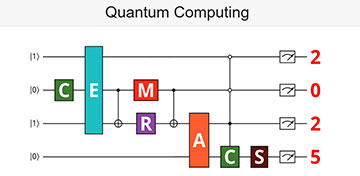 |
Join CEMRACS 2025, a unique Quantum Computing Summer School, for an intensive 6-week experience where academia and industry come together to drive real progress in quantum! |
| Information & Registration |
|
24 and 25 June: TQCI seminar on benchmarks for quantum computers |
 |
Relive the 3rd edition of the TQCI seminar dedicated to application benchmarks for quantum computers!
Don't miss the talks by French and international experts from the following institutions, initiatives or companies: RIKEN, IKS, IPHT, EuroHPC, CEA, BenchQC, QED-C, TNO, DG CONNECT, Unitary Fund, QCBC, Académie des Technologies, C12, Welinq, FU Berlin, UK Metrics, IBM, Poznan Supercomputing and Networking Center, Quantum benchmark Zoo, The Saudi Quantum Technology Association, CNRS, Microsoft, Thales, TotalEnergies, OrangeQS, UNISTRAand many more!
|
| Find the slides and videos here |
|
CASTIEL-2: Code of the Month vol.17 –Gysela, by EOCOE |
|
The GYSELA code is used to model turbulent transport in tokamak plasmas.
This new code will make it possible to use Exascale supercomputers that will be needed to model ITER plasmas.
The tokamak has been chosen for the international ITER project currently under construction on the Cadarache site in the south of France.
The success of this project depends in particular on understanding and predicting the turbulent transport of particles and heat within the plasma.
25th June 2025 @03:00 PM CEST
More information |
|
Digital Morning - HPC and AI for new materials and new molecules |

|
On April 8, 2025, the Matinale Digitale highlighted the contributions of HPC, AI and quantum computing to the discovery of new materials and molecules.
Speakers illustrated their concrete impacts on carbon capture, battery simulation and digital metallurgy for aeronautics. The event also highlighted the key role of these technologies in energy, health and construction, with a focus on emerging materials via the PEPR Diadem and collaborations between industrial, academic and institutional players.
Programme
Replay access |
|
|

